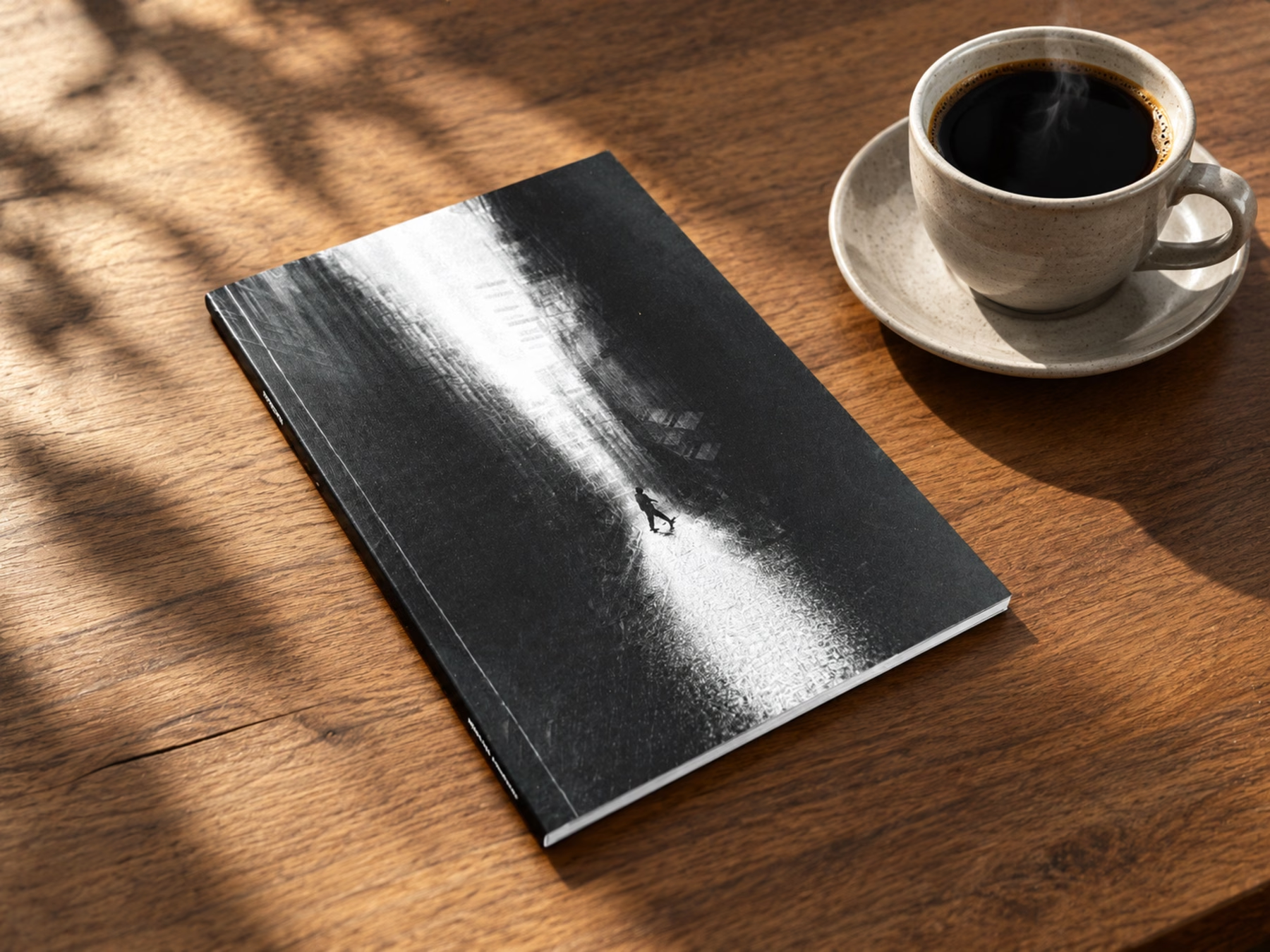
Dystopia
The city is both the greatest promise and the deepest contradiction of modernity. Today's metropolises continue to exist as gigantic organisms that regulate, direct and limit human life, while also constantly reconstructing the individual's memory, perception, and everyday experience. The "Dystopia" series consists of thirty-five photographs that visualize this fragile and contradictory urban existence.
This work exhibits a critical stance against the document function that photography has historically assumed. Just as Walter Benjamin pointed to the loss of the aura of art in the "age of mechanical reproduction", here too, photography ceases to be a fixed record of truth and turns into a field of visual intervention. Images produced by multiple exposures, deliberate camera movements and superimposed frames make the city space visible as a fragmented, multiplied and contradiction-woven plane by moving the city space away from being a fixed and reliable structure.
This approach reminds us of Paul Virilio's thoughts on speed, motion and optical consciousness. The experience of the city is transformed into a fragmented, temporary and fragile visual flow rather than a static observation. While the clarity of a single element (for example, a tram, a prominent building, or an architectural form) represents the functioning face of the system, the blurred, overlapped or decay structures surrounding its surroundings reveal the chaos behind this order. This tension makes the position of the individual visible in the modern city: a subject that is constantly alienated in the familiar.
When associated with Jean Baudrillard's thoughts on simulation and hyper-reality, “Dystopia” is not only an urban representation, but also a crisis of representation. Photographs dissolve the original references of the city while multiplying images; what remains is a visual plurality that endures on itself. This plurality invites the viewer into the familiar (tram, building, street), but at the same time breaks this familiarity, turning it into a restless stranger.
The use of color in the series deepens this conceptual framework. While the dominance of black and white carries urban experience to a historical memory or archive level, the selective use of red creates a visual interruption that points to violence, power and social tensions. In this context, "Dystopia" is not only an aesthetic preference, but an ideological reading proposal.
Viewed in the historical context of art, the work is in dialogue with the melancholic atmosphere that Eugène Atget established in the empty streets of Paris, with Moholy-Nagy's experimental modernist photography understanding and the fragmented visual language of Russian constructivists. However, "Dystopia" proposes a new form of representation, bringing this historical heritage to today's post-industrial, hyper-intense urban experience.
“Dystopia” transcends the documentary-based aesthetic tradition of urban photography, opening up a multi-layered space of inquiry at both the visual and intellectual level. While these photographs reveal the fragmented structure behind the visible face of the city, it also makes visible the instability of the photograph's relationship with the truth. It offers the viewer not only a visual experience, but also the opportunity to participate in a philosophical discussion: order and chaos, truth and representation, endless tension between acquaintance and stranger.
In conclusion, "Dystopia" is a work that reveals the dystopian nature of contemporary urban experience and proposes both an aesthetic and theoretical reading by expanding the boundaries of photography. This book is not only a visual album, but also a manifesto on the nature of the city and photography.
Publisher
Hüseyin Aldırmaz
Language
English/Turkish
Published
May 16, 2026
Pages
80
Cover
Soft cover
Dimensions
165 × 24 cm
Paper
Glossy
EUR 50

English, Türkçe
Hüseyin Aldırmaz, born in 1975, is a photographer and educator based in Istanbul. In his work, which focuses on street photography, he brings to light the invisible details of everyday life through a high-contrast aesthetic. For him, photography is not merely about capturing a moment; it is about pursuing the visual language created by light, shadow, and space.